What to know
- Many jobs do not include dental benefits. In March 2026, 44% of private-industry workers had access to dental coverage, compared with 71% who had access to medical coverage.
- Having dental insurance does not mean every bill is covered. Deductibles, coinsurance, annual maximums, and exclusions can still leave you with significant costs.
- Cosmetic treatment, such as whitening, is rarely covered. Orthodontic benefits vary by plan.
- Before treatment, ask what your plan covers, what it excludes, and what you are likely to owe.
- If you do not have insurance, an in-office membership plan may help
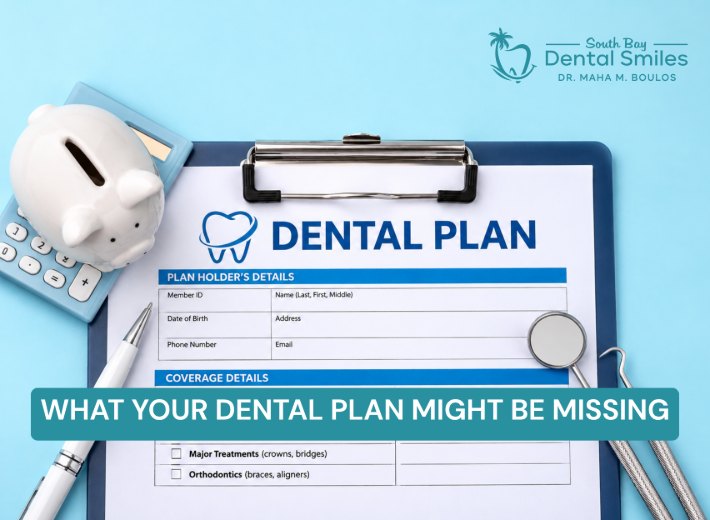
Open enrollment comes with plenty of decisions: medical coverage, retirement contributions, disability insurance. Dental coverage can be easy to overlook, until you need a filling, crown, or root canal and discover that the bill works very differently from a medical bill.
Dental benefits are far from universal. In March 2026, 44% of private-industry workers had access to dental coverage through work, compared with 71% who had access to medical coverage. Among state and local government workers, 62% had access to dental benefits.¹
Why dental coverage is easy to miss
Employer coverage is only part of the picture. A 2026 national survey by CareQuest Institute found that 28% of U.S. adults, about 76 million people, had no dental coverage. Medicare does not cover most dental services, Medicaid dental benefits for adults vary by state, and not every employer offers a plan.²
Dental insurance also works differently from most medical insurance. It is generally designed to encourage preventive care, then pay part of the cost of other treatment. That can help, but it can still leave patients with a sizable share of the bill.
What dental insurance usually pays
A common plan design covers preventive and diagnostic care, such as cleanings and exams, at 100%; basic services, such as fillings and root canals, at 80%; and major services, such as crowns, bridges, and implants, at 50%. A deductible may apply before the plan begins paying. Delta Dental uses that structure as an example, but your own plan may be different.³
Those limits tend to affect whether people finish treatment. CareQuest Institute estimates that about 32 million U.S. adults reached or exceeded their annual maximum. Among those adults, 46% said the limit kept them from seeking additional dental care.⁴
When appearance is the goal
Coverage usually depends on why a procedure is being done. Treatment that restores health or function may be covered in part. Treatment done only to change how a smile looks usually is not.
The American Dental Association defines cosmetic dentistry as care provided solely to improve appearance when form and function are already satisfactory. Whitening and veneers commonly fall into that category. Delta Dental says whitening is rarely covered, while coverage for braces depends on whether the plan includes orthodontic benefits.³
The distinctions are not always obvious to patients. A procedure can feel necessary to you and still be classified as cosmetic by the plan. Ask both the dental office and the insurer how the procedure will be coded before treatment begins.
Five questions to ask before treatment
A short call to your insurer, and a written estimate from the dental office, can prevent an unpleasant surprise. Ask:
- What is my annual maximum, and how much of it have I used?
- When does my plan year reset?
- Does my plan cover orthodontics?
- Which of my planned treatments count as cosmetic?
- Can I get a written estimate before treatment starts?
If you have little or no coverage
Some dental practices offer membership plans for patients who do not have insurance. These are not insurance policies; they are arrangements with a specific practice that may bundle preventive services and discount other treatment.
South Bay Dental Smiles currently offers three 12-month membership options: Child Complete at $29 a month or $348 a year; Adult Complete at $33 a month or $396 a year; and Periodontal at $51 a month or $612 a year. The practice says the plans have no deductibles, annual maximums, or preapprovals; include routine cleanings, exams, and X-rays at no extra cost; and provide 20% off fillings.⁵
Sources
1. U.S. Bureau of Labor Statistics, Employee Benefits in the United States, March 2026 (Sept. 25, 2026). Current BLS release
2. CareQuest Institute for Oral Health, State of Oral Health in America: Key Findings from 2026 (Aug. 2026). https://carequest.org/wp-content/uploads/2026/08/CareQuest_Institute_SOHEA-2026-Key-Findings_8.16.26.pdf
3. Delta Dental of Iowa, “Cosmetic Dental Procedures Classified: What Cosmetic Dentistry Means for Your Insurance” (accessed Oct. 17, 2026). https://www.deltadentalia.com/a-healthy-life/insurance/cosmetic-classified-what-it-mean-for-your-insurance-/
4. CareQuest Institute for Oral Health, Maxed Out: The Reality of Reaching Dental Insurance Limits (Feb. 2026). https://carequest.org/resource/maxed-out-the-reality-of-reaching-dental-insurance-limits/
5. South Bay Dental Smiles, “Dental Membership Plan” (prices and terms accessed Oct. 17, 2026). https://southbaydentalsmiles.com/financial/dental-membership-plan/