In brief
- The virome is the community of viruses that lives in and on the body—and scientists estimate that it may include more than 380 trillion viruses.
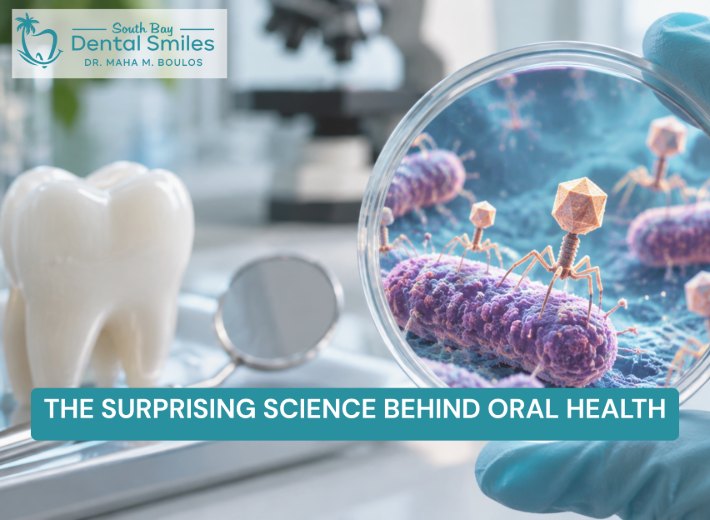
- Many of the viruses found in the mouth are bacteriophages, or “phages,” that infect bacteria rather than human cells.
- An NIH-funded team led by the UCLA School of Dentistry is helping define what a healthy virome looks like.
- The science may eventually support earlier, more personalized care, but it is still developing and does not change today’s oral-health advice.
A bustling world hiding in plain sight
Your mouth may feel like a quiet place between meals, but at the microscopic level it’s more like the 405. Scientists estimate that more than 380 trillion viruses live in and on the human body. Together, these viruses make up the virome.¹
That enormous number may sound alarming. It should not. Many of these viruses live alongside us without causing disease. Scientists have spent years mapping the bacteria that share our bodies. Now they are beginning to chart the much less familiar viral residents.¹²
Most oral viruses are not going after you
Many viruses identified in the mouth are bacteriophages, “phages” for short. Instead of infecting human cells, phages infect bacteria. A 2015 study found that phages make up much of the viral community detected on human body surfaces, including the mouth.³
Phages can kill bacteria or change how bacteria behave, so they may help shape the microbial community around your teeth and gums. Oral phage communities also vary from person to person and even from one part of the mouth to another. In other words, your oral virome may be as individual as your microbiome.³
Why a dental school is leading the search
The National Institutes of Health created the Human Virome Program to identify the viruses that naturally inhabit the body and learn how they affect health. As part of that effort, NIH awarded UCLA a $20.6 million, five-year grant to establish one of five Human Virome Characterization Centers. It is the largest NIH grant in the UCLA School of Dentistry’s 60-year history, and UCLA’s center is the only one headquartered at a dental school.²
UCLA researchers also wrote “Oral Virome in Health and Disease,” the cover story in the October 2026 issue of the Journal of the American Dental Association.¹ Their first challenge is basic but essential: define what a healthy virome looks like across the lifespan and among diverse populations. Without that baseline, scientists cannot confidently tell which viral changes are meaningful.¹²
Big possibilities, careful expectations
So where might this research lead? Somewhere useful eventually, but not tomorrow.
Researchers hope that a clearer picture of the healthy oral virome will reveal how viruses interact with the bacteria involved in gum disease and cavities, as well as with inflammation and the immune system.¹ One day, monitoring changes in saliva might help flag diseases in the body before symptoms appear or help dentists tailor prevention more closely to an individual patient. Those are promising goals but not tools currently available in the dental office.¹
The evidence also calls for humility. A 2026 systematic review examined 17 studies involving 623 patients. It found differences in phage communities between periodontal health and disease, but it did not show that phages cause gum disease.⁴ For now, researchers can see patterns; they are still working out what those patterns mean.
What this means for you today
For patients, the practical message is reassuringly simple: stay curious, not worried. Scientists are building the basic map, and any screening tests or treatments based on the virome would come later. This research does not change your current dental care.
While researchers explore this hidden ecosystem, the familiar basics still do the heavy lifting: brush with fluoride toothpaste, clean between your teeth, and keep regular dental visits. The tiniest residents of your mouth may be fascinating, but they have not made the toothbrush obsolete.
Sources
1. Mary Beth Versaci, "October JADA examines how human virome research could impact dentistry," ADA News, October 5, 2026. https://adanews.ada.org/ada-news/2026/october/october-jada-examines-how-human-virome-research-could-impact-dentistry/
2. UCLA Health, "UCLA to Lead $20.6M NIH-Funded Center to Unlock the Role of Viruses in Human Health," news release, February 5, 2025. https://www.uclahealth.org/news/release/ucla-lead-206m-nih-funded-center-unlock-role-viruses-human
3. Santiago-Rodriguez TM, et al. “Transcriptome analysis of bacteriophage communities in periodontal health and disease.” BMC Genomics. 2015;16:549. doi:10.1186/s12864-015-1781-0. https://link.springer.com/article/10.1186/s12864-015-1781-0
4. Bonilla M, El-Amrani S, Galindo-Moreno P, Mesa F. “Oral Phageome as Potential Modulators of Periodontal Dysbiosis: A Systematic Review.” Oral Diseases. 2026. doi:10.1111/odi.70327; PMID:42124328. https://www.bacteriophage.news/?p=13794